
Assembly Editor
Visual drag-and-drop editor for building automations, API endpoints, batch jobs, and widgets by connecting app integrations, triggers, and actions into assembly diagrams.
The assembly editor is a low-code drag-drop solution development tool.
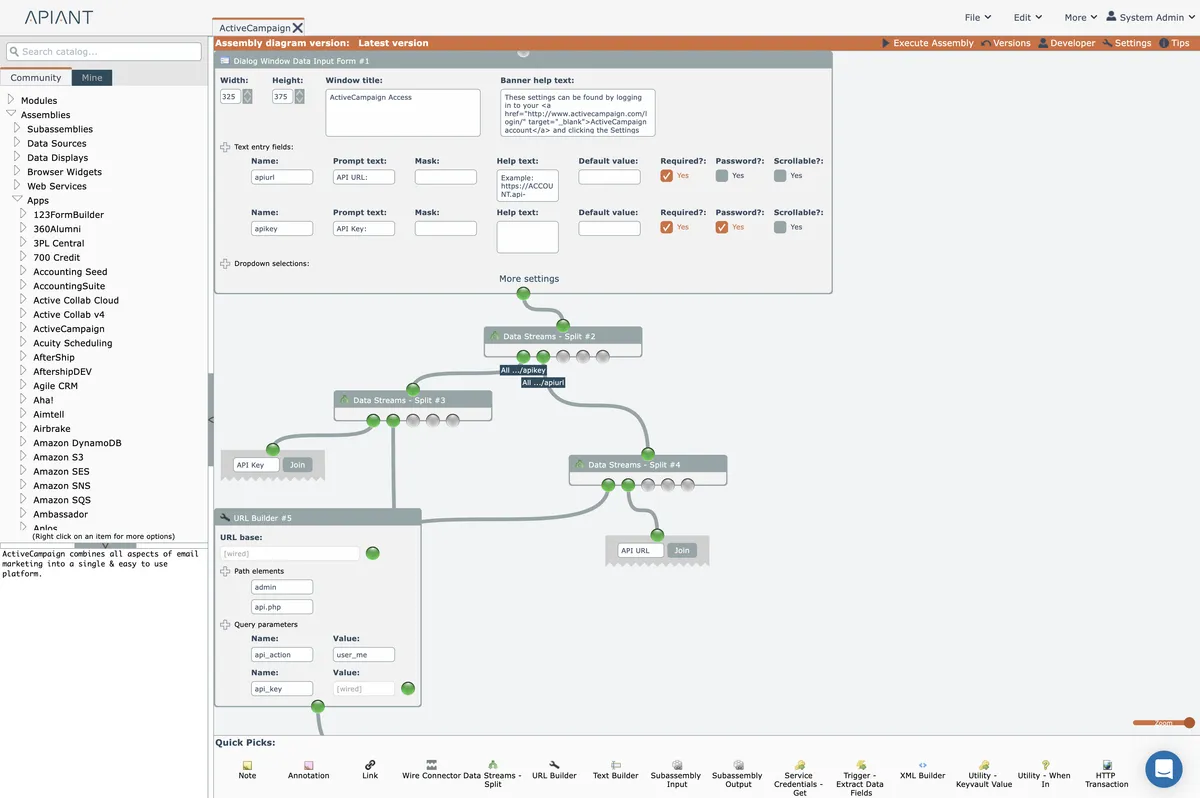
In terms of automations, all app connections, triggers, and actions are built as assembly diagrams.
The assembly editor is also capable of building other types of solutions besides automations, including REST-style endpoints, batch jobs, and even graphical browser widgets.
In this section
Account Management
Account management interface in the Assembly Editor is identical to the Automation Editor — see the Automation Editor documentation for account creation, switching, and role management.
API Credentials Management
Encrypted storage system for API credentials and OAuth secrets accessed from the Admin Console or Assembly Editor, with import/export functionality and keyvault value retrieval modules.
API Integrations
Build apps, triggers, and actions by creating assemblies in the Assembly Editor that control automation execution, configuration, and error handling.
Building Assemblies
Create solutions using a low-code drag-and-drop assembly editor that connects components visually without writing code.
Managing Content
Content management for assemblies and modules enables you to organize, update, and maintain your integration components throughout their lifecycle.
Other Assembly Types
Assembly types beyond the standard request-response pattern provide specialized integration capabilities for different workflow scenarios and data processing requirements.
Assembly Development Cycle
Assembly developers submit work for review to designated reviewers, receive feedback via email with annotations, and iterate on changes through a structured review workflow.
Module IDE
Native modules built with the Module IDE extend assembly functionality with optimized performance, created by copying existing modules and edited through the integrated development environment.
Keyvalue Storage
Generic database storage mechanism organized in a five-level hierarchy of scopes, key groups, keys, value names, and values with modules for inserting, retrieving, and deleting data.